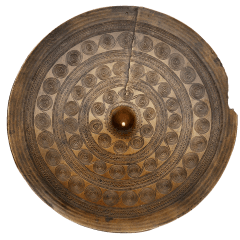
An interdisciplinary biography of the Viksø helmets.
A project financed by the Ministry of Culture Denmark FORMW.2022-0039 and executed at Moesgaard Museum 09/2022-06/2025.
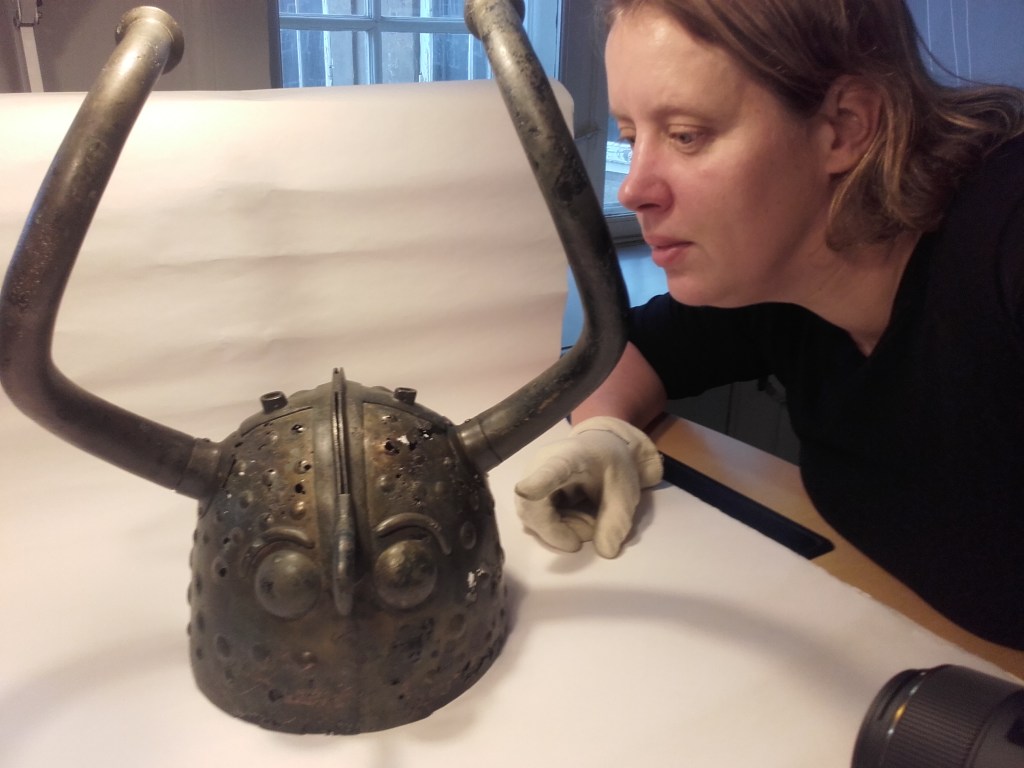
The Viksø helmets, found in 1942 in Brøns Mose near Viksø, have inspired writers and artists over decades in creating images of past warriors with horned helmets.
As a goldsmith, I was 2018 able to have a first look at the helmets and, as part of an investigation into the origins of Bronze Age metallurgy. Here new organic- and metal samples were obtained and questions arose related to the technical and material origin of the helmets and their network relations.
Project aims
… to create a complete artefact bio-graphy, including:
• A thorough craft-technical investigation of the helmets from a biographical perspective, answering questions regarding origin, import, transformation, and lifespan.
• An examination of the organic remains, from the inside of the helmet horns, to shed light on the questions of additional adornment.
• A comparison of the AMS radio-carbon dates with European Bronze Age armour to allow a well-founded classification of the find in the LBA material culture.
• A comparative provenance inves-tigation of the helmet’s metal to identify or exclude local manufacture (by comparison with contemporary cast debris) and define related net-works.
Questions…
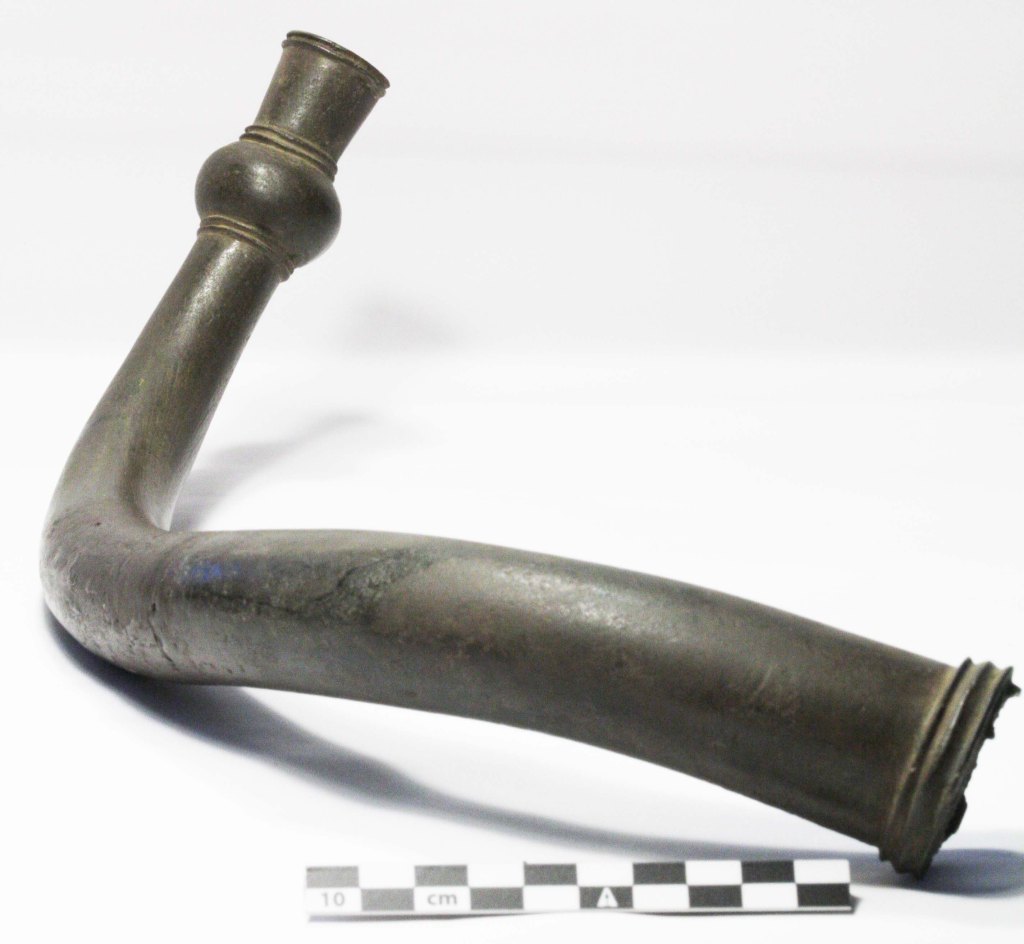
The project aims are related to open questions concerning the appearance of the slightly twisted horns, as asked in 1943 if it is “conceivable that the horns were made in this country and fitted with foreign helmets?” Also, assumptions concerning the crafting were made, by non-craftspeople, and they resulted in severe critique.
Background
In 1942, turf workers found two helmets in Brøns Mose near Viksø in north-eastern Zealand. A subsequent rescue excavation, supported by workers’ willingness to return memorabilia to the museum, enabled the nearly complete reconstruction of two large horned metal helmets likely placed on a wooden tray.
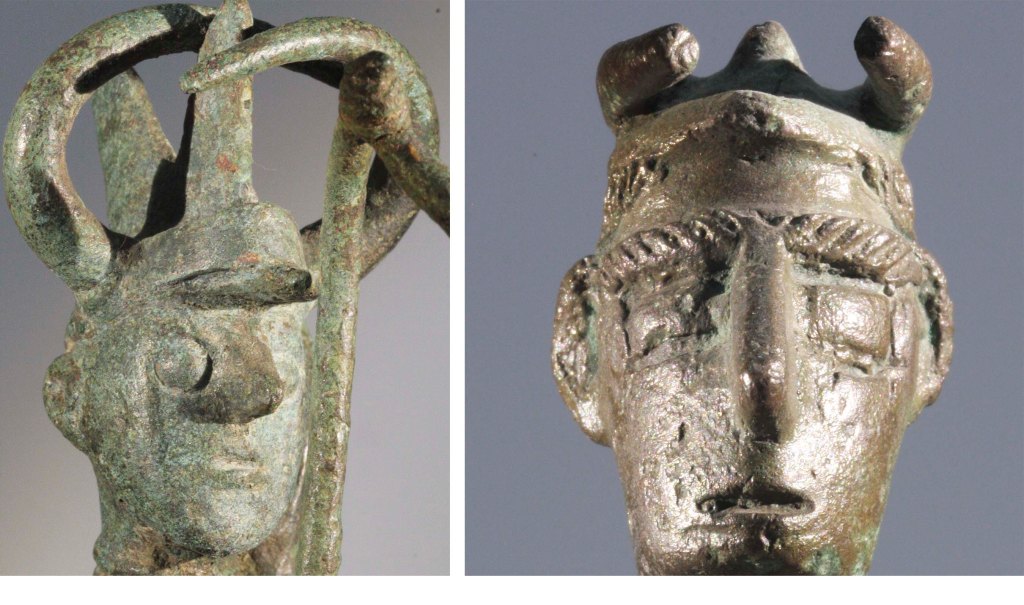
Technologically, the Viksø helmets are two-sheet helmets with the closest relatives in the small crested cap hel-mets that appeared from 1200 to 1100 BC in West and Central Europe, as this type combines a rounded helmet structure and top crest as seen at Viksø. The crest is attached through rivets and extends towards the sides. A beak-like extension is added at the front accompanied by attached eyebrows and large round eyes. Protruding humps cover the helm sheets, and round fittings holding a hol-low bronze horn sit on each side. Norling-Christensen’s initial description, the helmets are “provided with horns, and other strange things”, highlights the artefacts’ uniqueness. Only one comparable item, the bronze horn from Grevinge, Zealand, is known today.
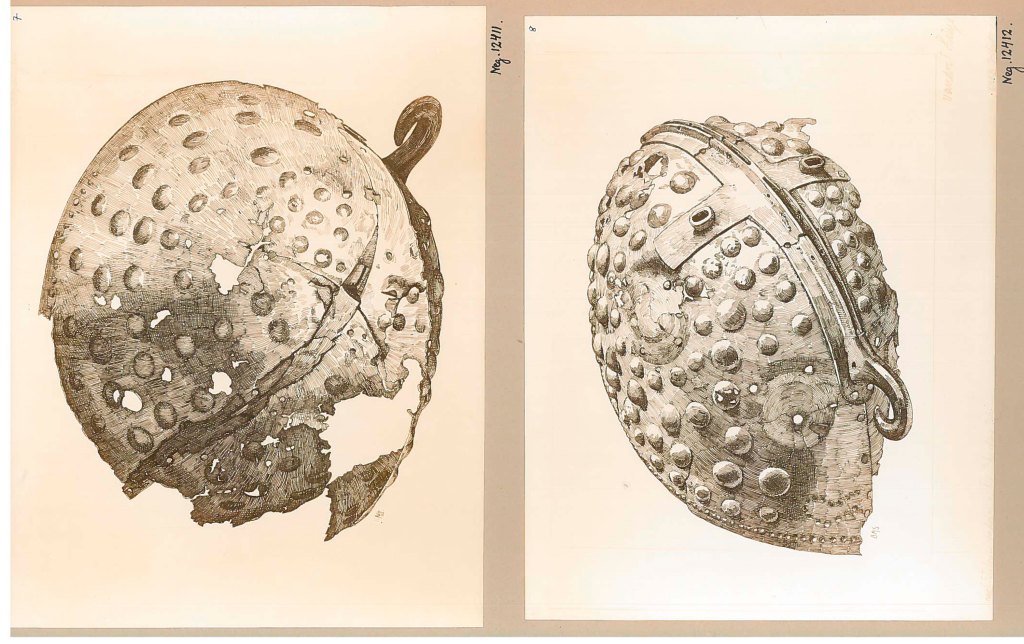
Despite their uniqueness, the helmet’s decorative style reveals parallels to the Central and East European Urnfield culture. Both the S-shaped hump decoration and the beak-like terminus of the helmet crest are frequent decor-ative elements in the Scandinavian LBA. Similarities to some technical features seen in Italian and French crest helmets were in one of the first comparative ex-aminations of the helmets identified by Henrik Thrane, like eyebrows on the piece from Corneto, Italy, or attached oval tubes at ear height on helmets from Bernières-d’Ailly. However, none of these helmets are fully comparable with Viksø. They are, as Marianne Mödlinger states, not within the technological tradition of the “western European helmets with crest and bivalve cap, nor with the eastern European cap helmets“. Their closest relatives are found in figurative art. In the 2nd millennium BC, bronze figures and rock art illustrations across Europe and the Mediterranean depict horned helmets on humans.
The analyses conducted as part of the project to trace the history of the Viksø helmet were:
- A technical examination of craftsmanship
- A metallurgical study using metal samples of the helmets and casting debris found in Denmark to:
- detect the metal composition (trace elements) to identify the alloy used and thus the technique
- define the lead isotopes to compare the origin of the copper used and thus the trade neworks
- An organic analysis of the organic material in the horns.
- A comparative study of sheet metal objects in Europe.
Project dissemination
- Invited lecture “Locally made or imported: the Viksø helmets reinvestigated”, within the Maritime Encounters Project Workshop “The Fröslunda shields and the Late Bronze Age World” Gothenburg University/ Durham University, Gothenburg 20–23 October 2025.
- Invited lecture “The Networks of the Horned Helmets”, at the 26th Nordic Spirit Symposium of the Scandinavian American Cultural and Historical Foundation, California Lutheran University, Thousand Oaks (California), 7-6 February 2025.
- 31st EAA Annual Meeting in Belgrade, Serbia (September 2025): “A biographical approach to the horned helmets”.
- ODM-møde, Vejle (11-12. November 2024): ”Viksø-hjelmenes oprindelse og behovet for at identificere den lokale metalpulje I yngre bronzealder i Danmark”
- 30th EAA Annual Meeting in Rome, Italy (September 2024): “Viksø helmets revisited: Locally made or imported from the South?”.
- Die Viksø Helme. Vortrag auf dem 5. NAHM-Workshops zum Thema „Toreutik“ – 18.‒20. Oktober 2023 am LVR-Landes Museum Bonn
- The Viksø helmets revisited. Poster presentation at the “Kultur-, naturhistorisk og kunstfagligt orienteringsmøde 2022”, November 2022; and the 7th International Kiel Conference of the Johanna Mestorf Academy (JMA) “Scales of Social, Environmental and Cultural Change in Past Societies” March 2023.
Project Publications
- 2025 -NØRGAARD, H. W., LING, J., BERGER, D., PERNICKA, E., STOS-GALE, Z. & MELHEIM, A. L. 2025. Bronze to Scandinavia. IN: Bronzization, 217-240.
- 2025 – NØRGAARD, H. W. 2025. Helm oder kein Helm: das ist hier die Frage! Eine erneute Begutachtung der gehörnten Helme von Viksø, Dänemark.
- 2023 –Viksøhjelmene i Den Store Danske lex.dk
- 2022 -NØRGAARD, H. W. 2022. Gehörnte Helme der Bronzezeit. Archäologie in Deutschland, 6/2022, 38-41.
- 2021 – CURRY, A. 2021. Bronze Age ‘power helmets’ unearthed from Danish bog. Science Magazine, 21/12/2021.
- 2021 –VANDKILDE, H., MATTA, V., AHLQVIST, L. & NØRGAARD, H. W. 2021. Anthropomorphised warlike beings with horned helmets: Bronze Age Scandinavia, Sardinia, and Iberia compared. Prähistorische Zeitschrift, aop, 1-29.
Results


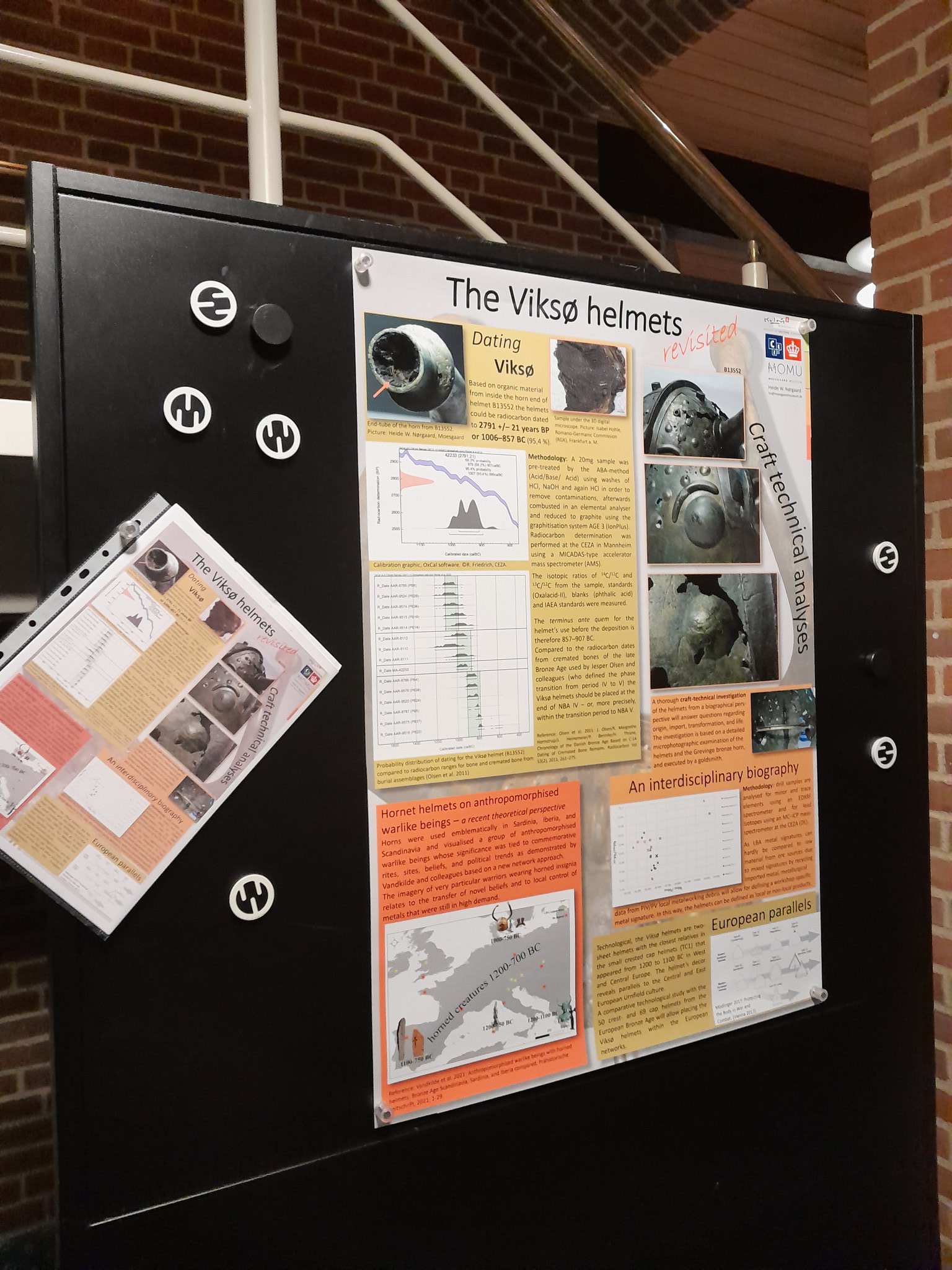

Dating of the Viksø helmets – natural scientific date ends typological stylistic debate.
Ancient Metals Newsletter, December 20/2023


During photographic documentation of the helmets in the winter of 2018, samples of the organic material inside the horn were taken, in addition to further metal samples from the horn of the Viksø helmet with the museum number B13552 (the metal samples will be part of a future newsletter). This 2 mm large piece of organic material, perhaps a tar-like substance, was well suited for radiocarbon dating.
The method of dating a piece of tar
The tiny fragment was cleaned from carbonate and humic acid impurities using the so-called ABA (acid/base/acid) method. In this pretreatment, the material is crushed and washed with muriatic acid (HCl), sodium hydroxide (NaOH) and muriatic acid (HCl)). The remaining impurity-free material was burned in an elemental analyser and reduced to graphite using the graphitisation system IonPlus, ALTER3 at the CEZA in Mannheim. The 14C content of the tar piece was measured using an AMS system (gas pedal coupled mass spectrometry) while, at the same time, additional samples were measured, where the radiocarbon ratios are known, so-called standards. The determined 14C ages were afterwards normalised and calibrated to calendar ages (1).
The radiocarbon date in relation to late Bronze Age developments
The C14 age of the organic remains inside the horn of helmet B13552 was measured as 2791 +/- 21 years BP (BP – years before today, i.e. 1950), giving a calibrated calendar date between 1006 and 857 BC (with 95.4% probability) or 976–907 BC. BC (with 68.2% probability).

Since we dated the material inside the horn that probably held some decoration, the measurements provide a date for the use of the helmet, not after 857-907 BC.
This new date can now be compared with known radiocarbon dates as it still has a pretty long duration, 1006 – 857 BC, to get a better idea of when the helmets most likely were used. Jesper Olsen dated, with the same method, in 2011 cremated bones from Late Bronze Age urn burials to define the phase transition of Periods IV and V.
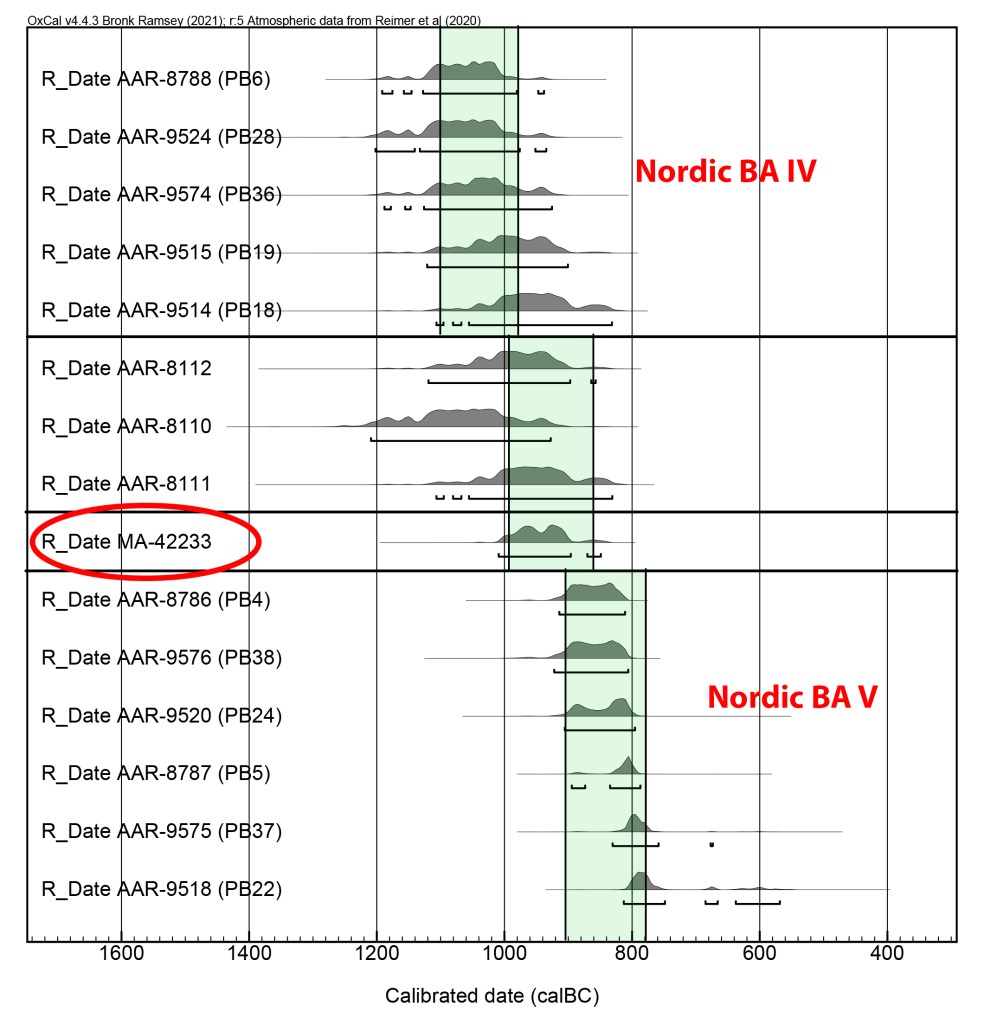
As urn burials are part of the well-known Bronze Age mounts burials, they often can be dated stratigraphically and thus indicate earlier and later burials. This direct comparison shows that our measured date of the helmets falls precisely into this specific phase transition between the Nordic Bronze Age IV and V. This means that the scientifically determined date that indicates the last use of the helmets can put an end to the stylistic discussions and prove both groups right. The Viksø helmets are a phenomenon of the late Period IV and early Period V, representing a period of upheaval.
(1) Normalisation of 14C ages to δ13C=-25‰ after Stuiver and Polach 1977 and calibration to calendar ages using the INTCAL13 data set and the SwissCal software (L.Wacker, ETH Zurich)
 Dr Heide Wrobel Nørgaard