Hvis du ikke havde mulighed for at deltage i MoMu-lørdagsforedraget og høre om, hvorfor vikingerne ikke bar hjelme med horn, er der nu en ny mulighed for at være med til at buste en myte! Idag åbnede bestil en forsker som del af forskningens døgn i April. Jeg er med, med mit foredrag om Viksø hjelmene. En historie om en myte og årsagen til, at vi tror, vikingerne havde horn på hjelmene. Men også en historie om bronzealderen og den første gang, vi virkelig kan tale om Europa. 3500 år før i dag var det område, vi i dag kender som forenede nationer fra Europa, allerede tæt forbundet på grund af metalhandel. Denne handel førte til udveksling af ideer, ritualer og et verdenssyn. Nysgerrig, book mig til et foredrag hos bestil en forsker på forsk.dk. Mit oplæg hedder: Ingen viking bærer hjelm med horn!
Dating of the Viksø helmets – natural scientific date ends typological stylistic debate.
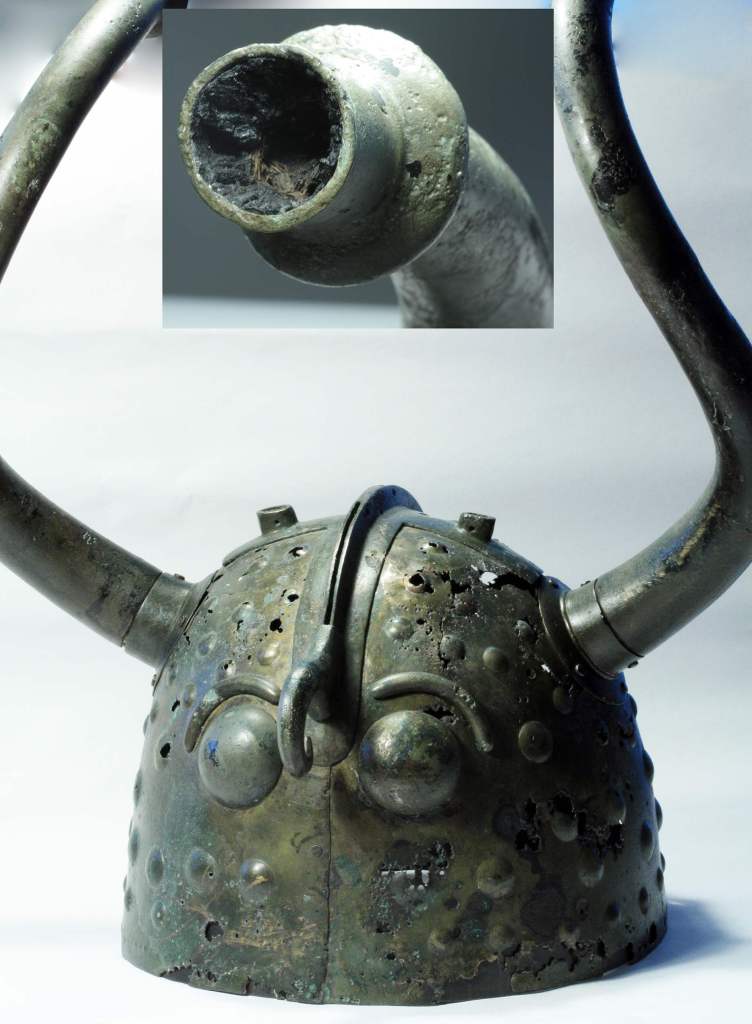
During photographic documentation of the helmets in the winter of 2018, samples of the organic material inside the horn were taken, in addition to further metal samples from the horn of the Viksø helmet with the museum number B13552 (the metal samples will be part of a future newsletter). This 2 mm large piece of organic material, perhaps a tar-like substance, was well suited for radiocarbon dating.
Examining the helmets at the National Museum of Denmark together with Flemming Kaul and conservator Louis Lange (picture: H. Nørgaard (remote).
The method of dating a piece of tar
The tiny fragment was cleaned from carbonate and humic acid impurities using the so-called ABA (acid/base/acid) method. In this pretreatment, the material is crushed and washed with muriatic acid (HCl), sodium hydroxide (NaOH) and muriatic acid (HCl)). The remaining impurity-free material was burned in an elemental analyser and reduced to graphite using the graphitisation system IonPlus, ALTER3 at the CEZA in Mannheim. The 14C content of the tar piece was measured using an AMS system (gas pedal coupled mass spectrometry) while, at the same time, additional samples were measured, where the radiocarbon ratios are known, so-called standards. The determined 14C ages were afterwards normalised and calibrated to calendar ages (1).
Radiocarbon date of the Viksø helmet compared to the dendro-curve (CEZA Mannheim)
The radiocarbon date in relation to late Bronze Age developments
The C14 age of the organic remains inside the horn of helmet B13552 was measured as 2791 +/- 21 years BP (BP – years before today, i.e. 1950), giving a calibrated calendar date between 1006 and 857 BC (with 95.4% probability) or 976–907 BC. BC (with 68.2% probability).
Since we dated the material inside the horn that probably held some decoration, the measurements provide a date for the use of the helmet, not after 857-907 BC.
This new date can now be compared with known radiocarbon dates as it still has a pretty long duration, 1006 – 857 BC, to get a better idea of when the helmets most likely were used. Jesper Olsen dated, with the same method, in 2011 cremated bones from Late Bronze Age urn burials to define the phase transition of Periods IV and V (Olsen et al. 2011).
As urn burials are part of the well-known Bronze Age mounts burials, they often can be dated stratigraphically and thus indicate earlier and later burials.
This direct comparison shows that our measured date of the helmets falls precisely into this specific phase transition between the Nordic Bronze Age IV and V. This means that the scientifically determined date that indicates the last use of the helmets can put an end to the stylistic discussions and prove both groups right. The Viksø helmets are a phenomenon of the late Period IV and early Period V, representing a period of upheaval.
The measured urn burials (see Olsen et al. 2011) compared to the Viksø date (plot: H. Nørgaard)
(1) Normalisation of 14C ages to δ13C=-25‰ after Stuiver and Polach 1977 and calibration to calendar ages using the INTCAL13 data set and the SwissCal software (L.Wacker, ETH Zurich)
OLSEN, J., HORNSTRUP, K. M., HEINEMEIER, J., BENNIKE, P. & THRANE, H. 2011. Chronology of the Danish Bronze Age Based on C-14 Dating of Cremated Bone Remains. Radicarbon, Vol 53, 261-275.
VANDKILDE, H., MATTA, V., AHLQVIST, L. & NØRGAARD, H. W. 2021. Anthropomorphised warlike beings with horned helmets: Bronze Age Scandinavia, Sardinia, and Iberia compared. Prähistorische Zeitschrift, aop, 1-29.
Practical Archaeometallurgy
As I often get asked what archaeometallurgy is and how archaeometallurgists work I will present within this chapter some basic techniques and methods used in archaeometallurgy that are necessary steps to answer archaeological questions. Archaeometallurgy is, as the website of the Historical Metallurgical Society states: “The archaeological study and reconstruction of early metallurgy, which can include any aspect of metal production and use up to the introduction of modern industrial processes.”
Besides detailed documentation of the archaeological features on site, often supported by geophysical investigations, archaeometallurgical tasks are executed in labs. Metallic remains or metallurgical debris need to be examined to answer questions concerning metal production. This can be done through a superficial examination and investigation, which is non-destructive and can inform about craft technical details, the individual craftsperson and workshops, when based on a large number of comparative examinations. However, more detailed questions concerning the production of metals require an investigation of the properties of the artefacts or debris.
This is done with the help of XRF and MS techniques, to determine the chemical and isotopic compositions, and with metallography, to determine the microstructure of the metals and as such the processes involved in the making. However, these techniques require pretreatment and partly hard and dirty work.
Part 1: cutting the sample
This short video shall show you the fun of working as an archaeometallurgist. It of course shall also inform you about the many steps needed before you can answer the above-stated questions. Within the archaeometallurgical everyday, the most seen artefacts and metallurgical debris are iron slags. The saw used to cut these slags is a diamond saw, low rotating and absolutely not dangerous for fingers as the saw blade needs to have a hard material to grab into. Work safety measures require safety glasses and a lab coat, as you really get dirty.
Selecting and cutting the material under investigation is the 1st step to get good results (picture: H. Nørgaard)
Archaeometallurgical News from a Scandinavian Perspective
Start of 2022 the news around the world reported that organic material from one of the horns of the Viksø helmets could be scientifically C14-dated and make their use around 950 BC very likely. Not surprisingly for Danish archaeologists, these helmets come from the late Bronze Age. What is surprising, however, is that this new date marks the first published scientific analysis of these artifacts. In October 2022, the Danish Cultural Ministry announced the newly financed research projects within the humanities and the project Viksø re-investigated was one of them! Following, I will spend the next years creating an interdisciplinary biography of the Viksø helmets. A combination of a craft-technical analysis, the archaeometallurgical fingerprint of the helmets, and local workshops combined with a stylistic and iconographic examination of contemporary helmets will give us new insights into the helmet’s origin and meaning!
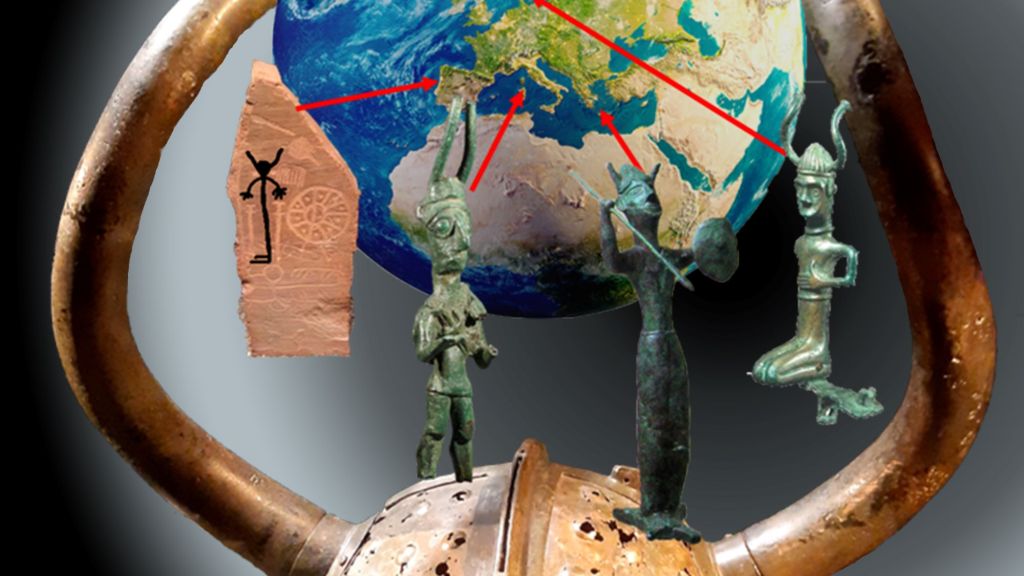
Yes, that is correct! They are part of a transfer of novel beliefs and cults that spread across Europe during the Late Bronze Age, around 1000 BC, as you can read in our new article published in Prähistorische Zeitschrift. The new radiocarbon date of one of the Viksø helmets did not confuse the archaeologists of this study, it supported much more what Danish research had long assumed. The interesting fact was, that the helmets date into a transition period within the Late Bronze Age. A detailed network analysis of the iconography revealed striking similarities between southwest Iberia, Sardinia and southern Scandinavia.
The sample for the new 14C date is taken from the horn opening (picture H. W. Nørgaard with permission by the National Museum Denmark)
This research was funded by the Cultural Ministry of Denmark. Only due to the collaboration with the National Museum Denmark and Moesgaard Museum, the Curt-Engelhorn-Centre in Mannheim, the Museo Archeologico Nazionale di Cagliari in Sardinia, the Archaeological superintendency of Sardinia this paper by Helle Vandkilde (Aarhus University), Valentina Matta (Aarhus University), Laura Ahlqvist (Aarhus University) and Heide W. Nørgaard (Moesgaard Museum) could be published.



 Dr Heide Wrobel Nørgaard