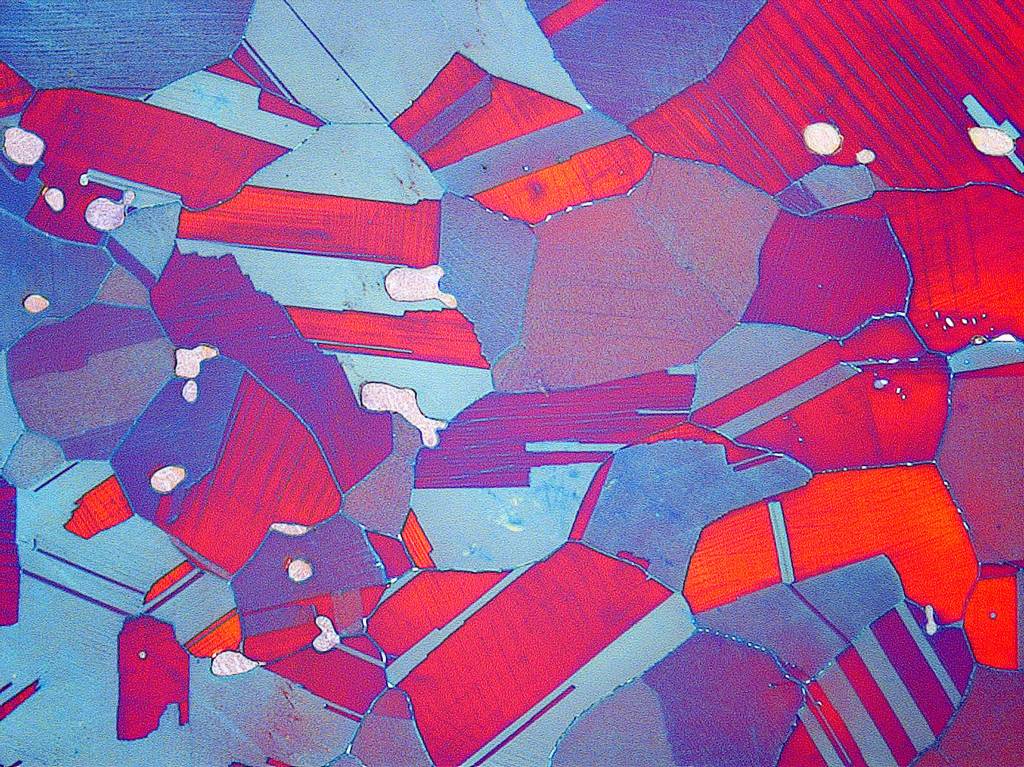
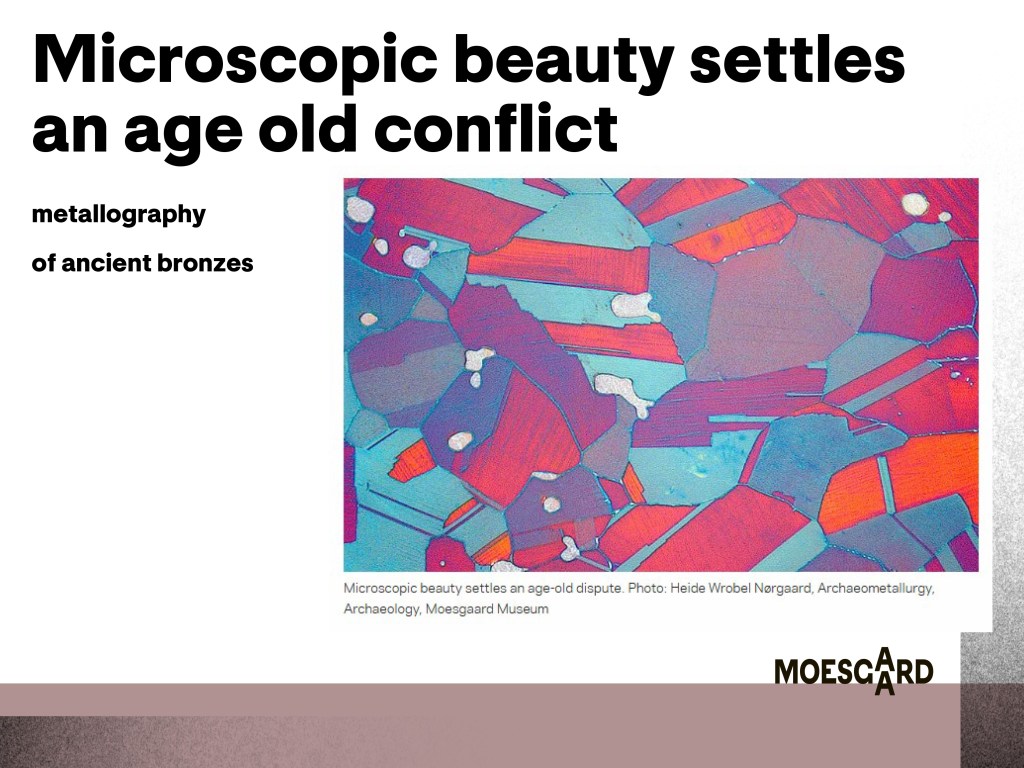
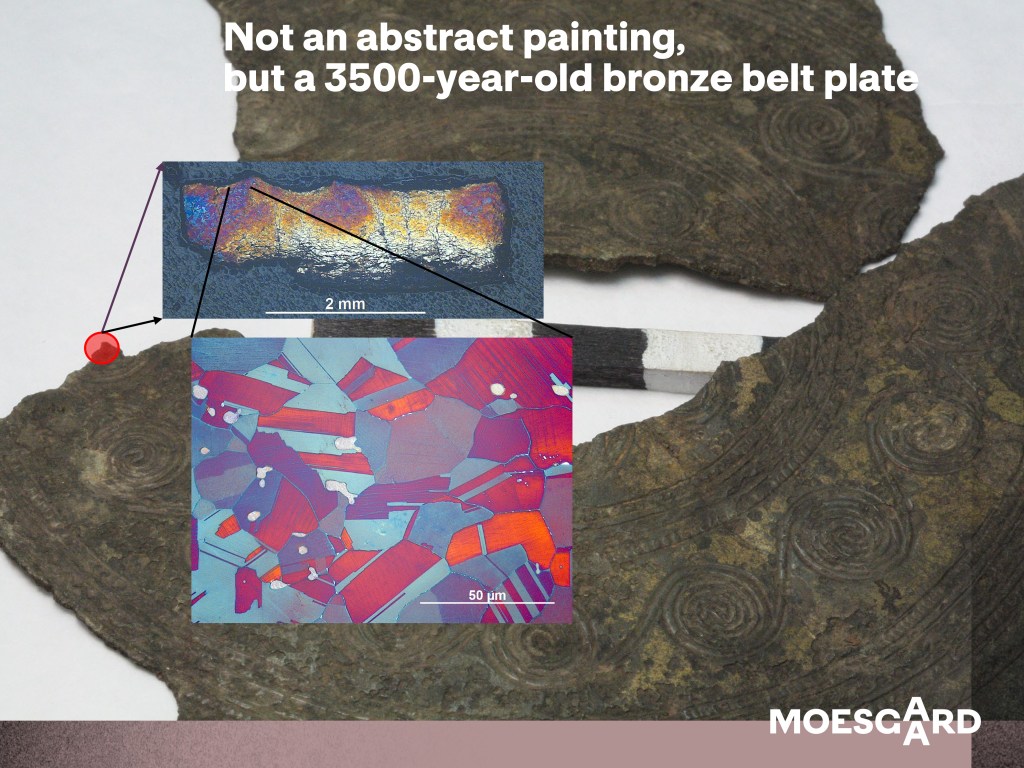
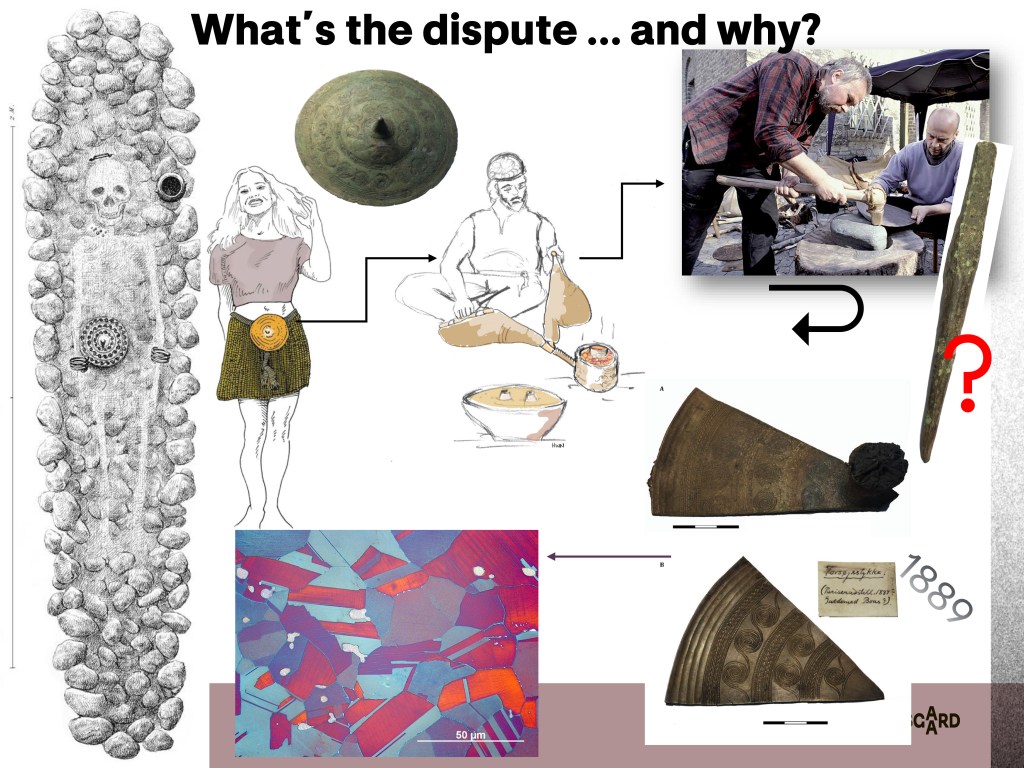
A microscopic image of a Bronze Age belt plate shows that the bronze disc was cast and finalised by forging (picture Heide W. Nørgaaard).
This micrograph of a 3,500-year-old bronze plate is key to understanding the technology and skill involved in making the large bronze jewellery that characterised the Danish Bronze Age and made this region unique. The production of these highly decorated objects has always been of public interest, as demonstrated by the attention it received from archaeologists since the inception of archaeology under J. J. A. Worsaae. In the 1870s, this practice sparked a debate among archaeologists, who doubted the feasibility of working bronze with bronze tools. First in the 1890´s the problem was solved through an experiment inititated by Sophus müller.
Vagn Frabricius Buchwald was the first person to apply the natural scientific method of metallography to Scandinavian prehistoric artefacts. This image of the crystallographic structure of a belt plate, prepared with a colouring etchant, proves that the bronze disc was cast and finalised by forging. Interdisciplinary research is the only way to solve disputes that have persisted for over a hundred years.
You want to know more? Watch a short video explaining the science behind the metallography on the Danish National Research Foundation homepage or here:
Craftspeople of 3,500-year-old jewellery can be traced through the traces they left.
This edition of the Ancient Metals newsletter aims to present some background to my approach on ancient metalwork. By examining Bronze Age artefacts, the trained eye can reveal whether the craftsperson used the right or left hand while crafting and in which relation the master and apprentice worked together. This could be demonstrated during my PhD studies a few years ago and the results can be read in the book “Bronze Age Metalwork” published by Archaeopress and open accessible for everyone.
It’s not exactly like getting the cell phone number of Bronze Age craftspeople, but it’s close.
Traces left of the crafting process on 3500-year-old bronze objects can be used to identify the craftsperson, his/her network and unique technical inventions! These traces witness the making of the artefact and are unique to each craftsperson. The study of bronze jewellery from Denmark and Northern Germany revealed some spectacular results. Among other things, it was shown that Bronze Age finesmiths used unique tools such as their nails and individually made spiral stamps to create the rich decoration on the jewellery. A comparison of traces on hundreds of artefacts made it possible to determine workshops and their supply area. Some of these workshops in Danmark were connected through an active exchange of knowledge, likely through people’s active mobility. The connection reached as far as northern Germany, as some tool traces could prove.
It is very likely that the exchange of apprentices was already introduced in the Bronze Age to secure an ongoing development in technological solutions, styles and ideas.
The objects made in the workshop in northern Zealand are characterized by a broad triangular decorative element, spirals with short round centre –and half-round impressions and an antler-like end at the rib notches. This workshop stands for producing the largest belt plates in the middle Bronze Age and is present in every large bronze hoard at this time.
For example, a workshop existed in the north of Zealand during the middle Bronze Age, where many of the largest belt ornaments were made. Objects from this workshop are characterized by a distinct triangular pattern, large, very dense spirals and hourglass impressions with two different ends (see figure). The Langstrup beltplate, which we know from the Danish 200,- Kr. Notes, was made in another workshop on Zealand, a few hundred kilometres to the west. The best way to separate the works of these two large workshops is to look at how the long spike was added to the disc. Both workshops used a highly specialized technique: the decorated flat plate was made first and the spike was cast onto the plate. In the workshop where the Langstrup plate was made, the craftspeople cast the spike from the top, looking at the decorated part of the disc—the northern workshop from the bottom.
“How should we be able to see who made the Langstrup belt plate? “
You need to look at the Bronze Age objects to see manufacturing traces. You need to get familiar with every bit of detail of the piece. Such traces can be errors in the decoration, markers of specific techniques or impressions of special tools. It is sometimes enough to look at the objects with the naked eye. In any case, magnification through a camera lens is sufficient! However, basic metallurgical knowledge is necessary to understand these traces, and an education as a goldsmith helps a lot. Knowing the basic techniques of metalworking makes it possible to associate certain defects with specific techniques. The properties of the metal are the same from 3500 years ago and today. As such, similar tools will leave the same impressions.
A close-up of the Langstrup belt plate and its largest spiral row. Combining two halves of different spirals can prove that these spirals are made with a tool that can impress identical impressions in a wax model. The spirals are in such detail identical that the centre, the single turns and the impression depth are so similar that both spiral halves complete each other.
For the next step you need imagination. Is the left side of one spiral from the Langstrup belt plate identical and can be fitted perfectly with the right side of the neighbouring spiral, these spirals must be inserted with the same tool. If all spirals are identical and small errors appear in the same place on successive spirals, the tool used must have been a stamp. Thus, the spirals on the Langstrup belt plate are made using a stamp (see figure).
Preserved mistakes in the decoration are the starting point for finding out who made the object. We know some basic behavioural patterns in the way we humans work. These are described in a philosophical and anthropological concept called habitus. Based on this concept, we can define work patterns, typical mistakes, and techniques unique to a craftsperson. Using the same background, we can assign a specific piece of jewellery to one particular region. The society around us, our region-specific worldview and ingrained customs influence us as people in our upbringing and in the way we learn. This concept can answer why we do things the way we do! We have learned to do it in a certain way.
“However, you cannot work metal with fingernails!”
That is absolutely true; bronze is too hard to be worked with tools that are softer than the bronze itself. The detected tool traces, such as nail prints, show that the artefacts were made using the lost-wax method. Bronze Age fine smiths started by melting beeswax and adding fat and minerals to make the wax less sticky. Afterwards, the wax can be shaped as desired and decorated with fingers, wooden tools, and hair. The stamps used for the spirals were most likely modelled from horsehair (see figure). Embedded in fat and twisted, even a few hairs would create a stable shape that could be used multiple times when fitted on a handle. The almost finished model is wrapped in several different clay layers and fired so that the wax melts and leaves a negative of the desired object. Many of the examined ornaments and weapons show that they have been worked a final time after casting with bronze tools.
Spirals impressed using a stamp on a belt plate found in Hungary. This belt plate is very similar to objects found on the Danish Isles. The spiral impressions are in width and depth comparable to a horse hair. Some minor but recurring mistakes in the curling could be related to the faulty creation of the stamp.
…
And here the chapter ends for now. For this time there is enough information to be processed. In the next issue of Ancient Metals, we will continue with this topic and explore how crafting traces can illuminate master-apprentice relationships and exchange of craftspeople in the Bronze Age.
Practical Archaeometallurgy 2
In the last issue, I started the chapter series Practical Archaeometallurgy to answer the many questions that may arise when thinking about archaeometallurgy and how archaeometallurgists work. The aim is to present within this chapter some basic techniques and methods used in archaeometallurgy that are necessary to answer archaeological questions.
We learned how to cut a sample. In this case, the cutting of slag samples with a diamond blade saw was illustrated. It might be worth mentioning that some samples need to be treated with much more care, like bronze samples. Here a goldsmith saw is an often-used tool. It is recommended to have some other devices and tools with you when you plan to sample bronze artefacts, such as a leather cloth (to catch the jumping sample), a long rectangular piece of hardwood and a pair of clamps (see figure).
Cutting a small bronze sample with a goldsmith saw, picture Louise Felding.
When the sample has the desired size, it needs to be prepared for grinding. Large samples could be ground without a working step in between. Small samples cannot be handled without a proper base. Here, archaeometallurgists use epoxy resins to mount the samples in small round mounting cups. This procedure is called cold mounting and uses, besides the small plastic cups, a two-component resin. The World Wide Web has several guidelines and tutorials that explain step by step the needed procedure to succeed with the mounting (see https://en.archaeometallurgie.de/how-to-sample-mounting/).
The working steps of the cold mounting process, pictures Heide Nørgaard.
However, I would like to add some tips (I myself have been told by my teachers) that will make the procedure more straightforward. Be careful when sorting the small fragments you want to fix in the mould. Remember the labels! All the way through the process have the labels next to the metal pieces and add them to the cast. The mounted samples will appear mirrored in your finished block! Be careful with the epoxy. In Danmark, the handling of epoxy requires specific training and a certificate which indicates how dangerous this material is for your health (wear gloves and goggles). Have enough time! Working with such small samples cannot be done in haste. Finally, you have to allow for more time because the epoxy needs to dry for at least 24 hours.
You see, lab work is fun as you can nearly finish your listening books while mounting samples!
Dating of the Viksø helmets – natural scientific date ends typological stylistic debate.
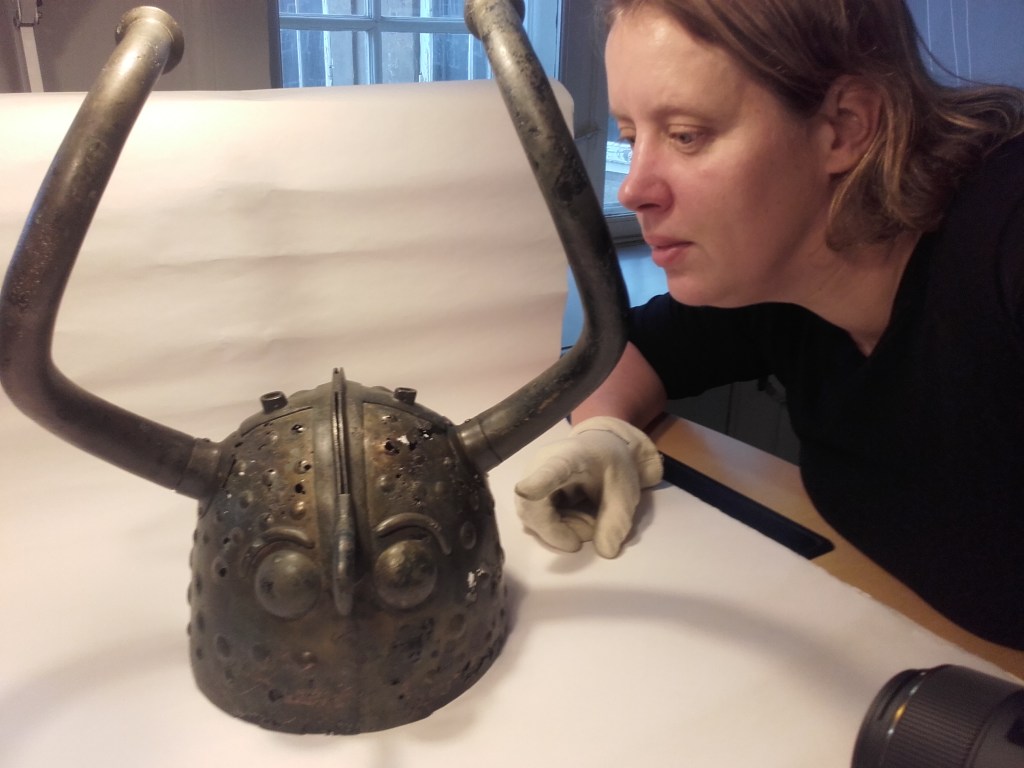
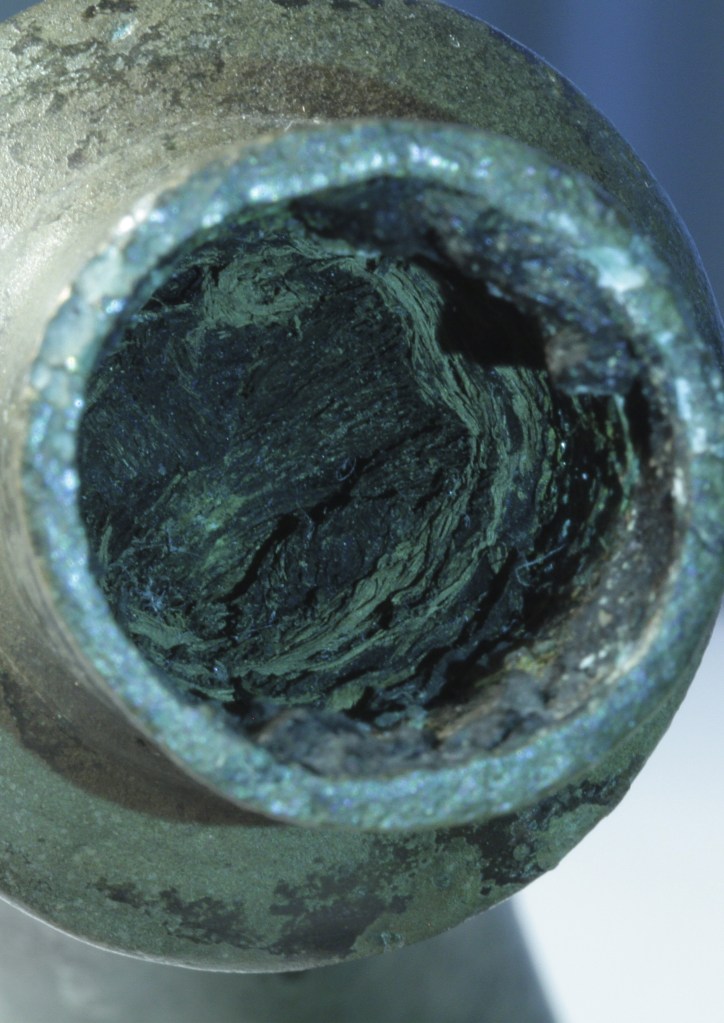
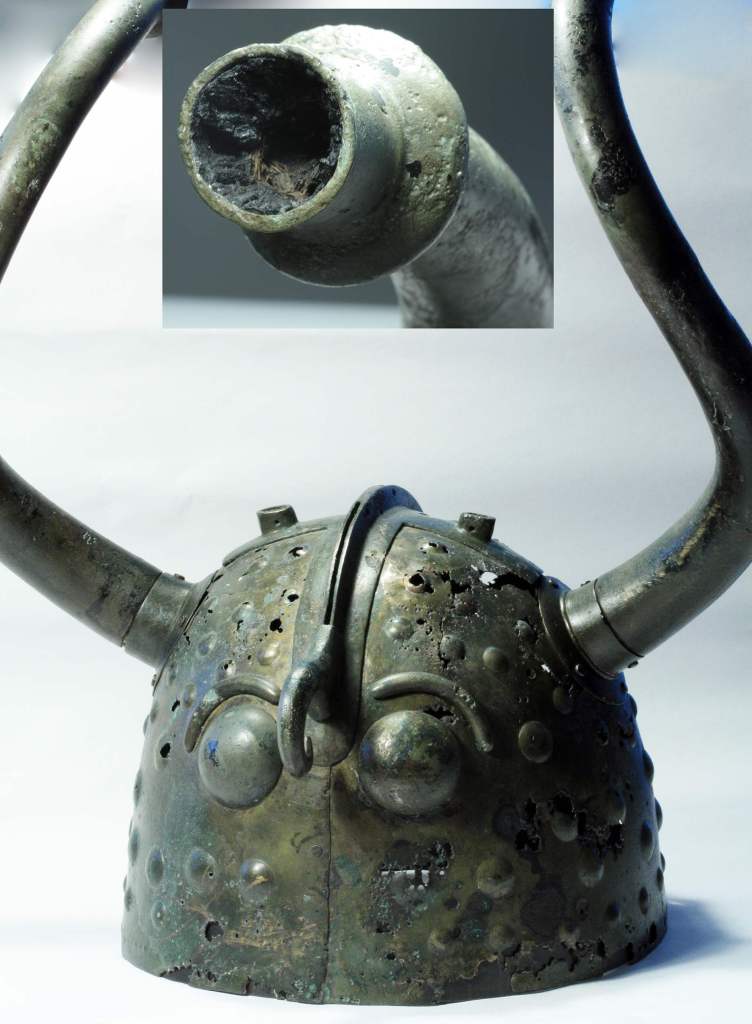
During photographic documentation of the helmets in the winter of 2018, samples of the organic material inside the horn were taken, in addition to further metal samples from the horn of the Viksø helmet with the museum number B13552 (the metal samples will be part of a future newsletter). This 2 mm large piece of organic material, perhaps a tar-like substance, was well suited for radiocarbon dating.
Examining the helmets at the National Museum of Denmark together with Flemming Kaul and conservator Louis Lange (picture: H. Nørgaard (remote).
The method of dating a piece of tar
The tiny fragment was cleaned from carbonate and humic acid impurities using the so-called ABA (acid/base/acid) method. In this pretreatment, the material is crushed and washed with muriatic acid (HCl), sodium hydroxide (NaOH) and muriatic acid (HCl)). The remaining impurity-free material was burned in an elemental analyser and reduced to graphite using the graphitisation system IonPlus, ALTER3 at the CEZA in Mannheim. The 14C content of the tar piece was measured using an AMS system (gas pedal coupled mass spectrometry) while, at the same time, additional samples were measured, where the radiocarbon ratios are known, so-called standards. The determined 14C ages were afterwards normalised and calibrated to calendar ages (1).
Radiocarbon date of the Viksø helmet compared to the dendro-curve (CEZA Mannheim)
The radiocarbon date in relation to late Bronze Age developments
The C14 age of the organic remains inside the horn of helmet B13552 was measured as 2791 +/- 21 years BP (BP – years before today, i.e. 1950), giving a calibrated calendar date between 1006 and 857 BC (with 95.4% probability) or 976–907 BC. BC (with 68.2% probability).
Since we dated the material inside the horn that probably held some decoration, the measurements provide a date for the use of the helmet, not after 857-907 BC.
This new date can now be compared with known radiocarbon dates as it still has a pretty long duration, 1006 – 857 BC, to get a better idea of when the helmets most likely were used. Jesper Olsen dated, with the same method, in 2011 cremated bones from Late Bronze Age urn burials to define the phase transition of Periods IV and V (Olsen et al. 2011).
As urn burials are part of the well-known Bronze Age mounts burials, they often can be dated stratigraphically and thus indicate earlier and later burials.
This direct comparison shows that our measured date of the helmets falls precisely into this specific phase transition between the Nordic Bronze Age IV and V. This means that the scientifically determined date that indicates the last use of the helmets can put an end to the stylistic discussions and prove both groups right. The Viksø helmets are a phenomenon of the late Period IV and early Period V, representing a period of upheaval.
The measured urn burials (see Olsen et al. 2011) compared to the Viksø date (plot: H. Nørgaard)
(1) Normalisation of 14C ages to δ13C=-25‰ after Stuiver and Polach 1977 and calibration to calendar ages using the INTCAL13 data set and the SwissCal software (L.Wacker, ETH Zurich)
OLSEN, J., HORNSTRUP, K. M., HEINEMEIER, J., BENNIKE, P. & THRANE, H. 2011. Chronology of the Danish Bronze Age Based on C-14 Dating of Cremated Bone Remains. Radicarbon, Vol 53, 261-275.
VANDKILDE, H., MATTA, V., AHLQVIST, L. & NØRGAARD, H. W. 2021. Anthropomorphised warlike beings with horned helmets: Bronze Age Scandinavia, Sardinia, and Iberia compared. Prähistorische Zeitschrift, aop, 1-29.
Practical Archaeometallurgy
As I often get asked what archaeometallurgy is and how archaeometallurgists work I will present within this chapter some basic techniques and methods used in archaeometallurgy that are necessary steps to answer archaeological questions. Archaeometallurgy is, as the website of the Historical Metallurgical Society states: “The archaeological study and reconstruction of early metallurgy, which can include any aspect of metal production and use up to the introduction of modern industrial processes.”
Besides detailed documentation of the archaeological features on site, often supported by geophysical investigations, archaeometallurgical tasks are executed in labs. Metallic remains or metallurgical debris need to be examined to answer questions concerning metal production. This can be done through a superficial examination and investigation, which is non-destructive and can inform about craft technical details, the individual craftsperson and workshops, when based on a large number of comparative examinations. However, more detailed questions concerning the production of metals require an investigation of the properties of the artefacts or debris.
This is done with the help of XRF and MS techniques, to determine the chemical and isotopic compositions, and with metallography, to determine the microstructure of the metals and as such the processes involved in the making. However, these techniques require pretreatment and partly hard and dirty work.
Part 1: cutting the sample
This short video shall show you the fun of working as an archaeometallurgist. It of course shall also inform you about the many steps needed before you can answer the above-stated questions. Within the archaeometallurgical everyday, the most seen artefacts and metallurgical debris are iron slags. The saw used to cut these slags is a diamond saw, low rotating and absolutely not dangerous for fingers as the saw blade needs to have a hard material to grab into. Work safety measures require safety glasses and a lab coat, as you really get dirty.
Selecting and cutting the material under investigation is the 1st step to get good results (picture: H. Nørgaard)
Archaeometallurgical News from a Scandinavian Perspective
Bliv klogere på de hornede hjelme og spis dig mæt i den lækre buffet til MOMU-lørdag.
Der er faktisk slet ikke noget, der tyder på, at vikingerne bar hjelme med horn. Tværtimod, så har nyere kulstof-14 undersøgelser foretaget på de hornede hjelme fra Viksø vist, at hornede hjelme faktisk var et fænomen i bronzealderen i stedet.
Men hvor stammer myten om vikingernes hornede hjelme så fra og hvilke hemmeligheder holder hjelmene fra Viksø på? Køb billet til MOMU-lørdag og bliv både klogere og dejlig mæt. Jeg glæder mig meget til at fortælle om de eneste bronzehjelm med horn som findes – hjelmene fra Viksø.
My completed research project on the connections between female mobility and metal trade in Bronze Age northern Europe resulted in the idea of ambassadors. Here, ambassadors are seen as people, female as male, who connect social groups and establish and maintain networks. These networks involve the trade of metals and other goods, leading to an increasing exchange of people and, thus, knowledge. The exchange of knowledge is fundamental for social development.
For more, join my forthcoming lectures on this topic at:
the Kiel Conference 2023: Scales of Social, Environmental and Cultural Change in past Societies #KielScales23, Session 1, Monday 13th March 16.00.
and at the EEA Meeting in Belfast 30th August – 2nd September 2023, Session: #480, Metals and Metalworking I
Start of 2022 the news around the world reported that organic material from one of the horns of the Viksø helmets could be scientifically C14-dated and make their use around 950 BC very likely. Not surprisingly for Danish archaeologists, these helmets come from the late Bronze Age. What is surprising, however, is that this new date marks the first published scientific analysis of these artifacts. In October 2022, the Danish Cultural Ministry announced the newly financed research projects within the humanities and the project Viksø re-investigated was one of them! Following, I will spend the next years creating an interdisciplinary biography of the Viksø helmets. A combination of a craft-technical analysis, the archaeometallurgical fingerprint of the helmets, and local workshops combined with a stylistic and iconographic examination of contemporary helmets will give us new insights into the helmet’s origin and meaning!
From the 11th to 15th of September I had the pleasure to present my research and theoretical methodology to craft in prehistoric times at the MINERVA school workshop “Crafting for the God(s)”. The intellectual exchange between the many different research fields gathered at this workshop allowed fruitful discussions and opened my mind to a more ritual perspective on craft.
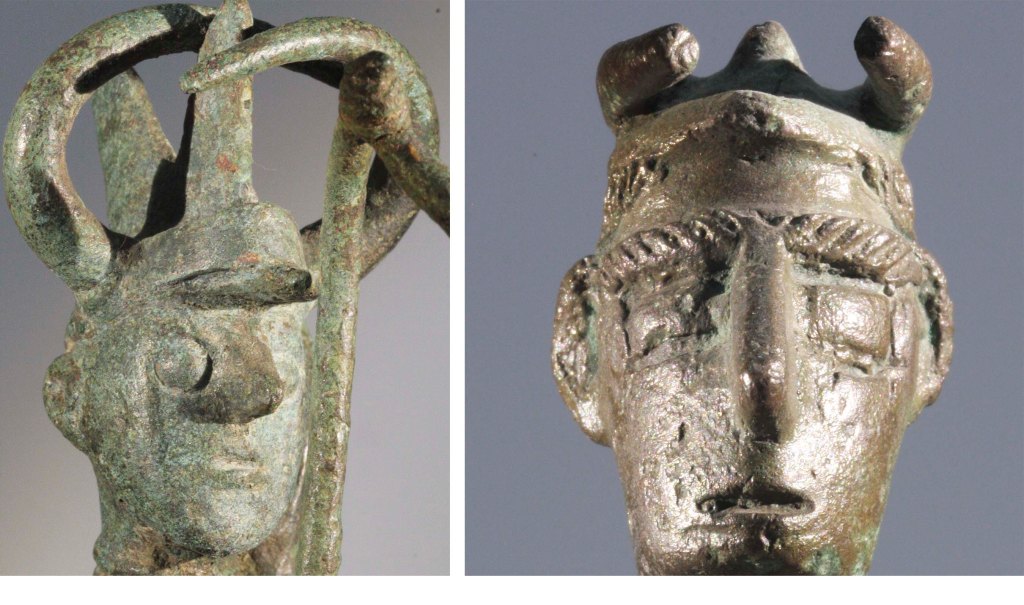
Yes, that is correct! They are part of a transfer of novel beliefs and cults that spread across Europe during the Late Bronze Age, around 1000 BC, as you can read in our new article published in Prähistorische Zeitschrift. The new radiocarbon date of one of the Viksø helmets did not confuse the archaeologists of this study, it supported much more what Danish research had long assumed. The interesting fact was, that the helmets date into a transition period within the Late Bronze Age. A detailed network analysis of the iconography revealed striking similarities between southwest Iberia, Sardinia and southern Scandinavia.
The sample for the new 14C date is taken from the horn opening (picture H. W. Nørgaard with permission by the National Museum Denmark)
This research was funded by the Cultural Ministry of Denmark. Only due to the collaboration with the National Museum Denmark and Moesgaard Museum, the Curt-Engelhorn-Centre in Mannheim, the Museo Archeologico Nazionale di Cagliari in Sardinia, the Archaeological superintendency of Sardinia this paper by Helle Vandkilde (Aarhus University), Valentina Matta (Aarhus University), Laura Ahlqvist (Aarhus University) and Heide W. Nørgaard (Moesgaard Museum) could be published.
Today our article “Anthropomorphised warlike beings with horned helmets: Bronze Age Scandinavia, Sardinia, and Iberia compared”, written by Helle Vandkilde, Valentina Matta, Laura Ahlqvist and me, was published open access in Prähistorische Zeitschrift. It includes a brand-new C14-dating of the famous Viksø-helmets, a detailed network analysis of the iconography related to horned helmets and some ideas to how the similarity between Scandinavia, Sardinia and Iberia could be understood.
See what SCIENCE is writing about our new article…




 Dr Heide Wrobel Nørgaard